Security operations, connected
SOCPilots
See the signal.
Understand the story.
Connect your SIEM, investigate with context, and turn evidence into a response your team can stand behind.
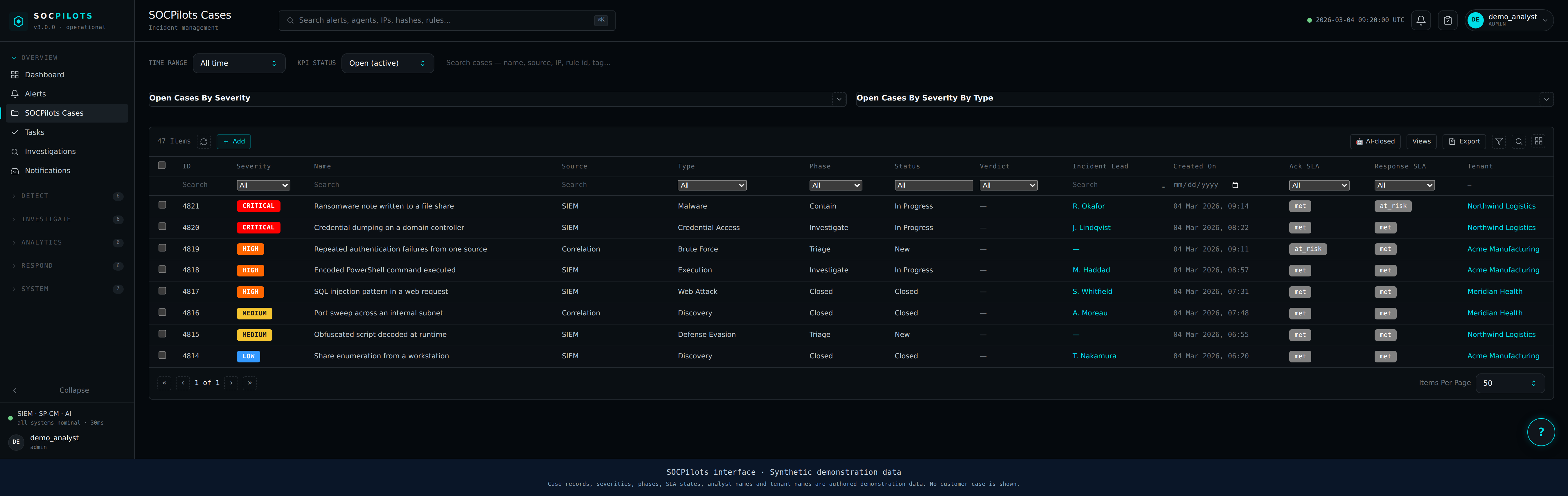
Inside the console
Evidence. Ownership. A recorded decision.
Real application view with synthetic data. Explore the case record, then follow the investigation.
Multi-Layer AI™
From a warning
to a clearer decision.
Give your team a head start: gather context, connect the evidence and prepare the investigation for review. Available checks depend on your connected services and AI configuration.
A security alert starts the investigation.
Example investigation with synthetic data. This animation does not access your systems or take action.
- Less manual gatheringBring relevant context into the investigation.
- Clearer handoversKeep observations and findings together.
- Decisions you can explainReview the evidence before approving a response.
An alert. A place to start.
A suspicious attempt to access credentials arrives from your SIEM. SOCPilots keeps the original event attached, so the investigation starts with evidence.
- What it brings together
- The original alert and its timeline
- For your team
- Your team knows what happened and where to look
Automation with accountability
Move the work forward.
Keep the decision yours.
From a source alert to a recorded outcome, with a clear point for human review. Connector actions depend on your environment and policy.
- 01 / TRIGGER
Alert received
Source and event context
- 02 / INVESTIGATE
Enrich evidence
Tools and entity relationships
- 03 / APPROVAL
Awaiting review
Analyst evaluates the proposal
PAUSED - 04 / RESPONSE
Connector action
Only after required approval
NOT EXECUTED
A console that already did the collecting
Six things happen between an alert firing and an analyst forming a judgement. SOCPilots does all six in one place, against whichever SIEM is underneath.
Detection, investigation, response and operational capabilities
Detection and triage
alertsAlerts stream in from your SIEM, deduplicate into cases, and get scored against asset criticality and threat intelligence. Where the evidence is unambiguous the case is dispositioned without waiting for a human. The queue an analyst opens has already had the obvious work taken out of it.
Investigation
agentAsk a question in plain language. The agent reasons in a loop — searching alerts, enriching indicators, checking prior cases, reading the behaviour graph and the asset inventory — until it can answer. Every step it took is stored alongside the answer, so the reasoning is reviewable rather than asserted.
Automation and response
playbooksBuild response in a visual designer and run it durably. Runs survive a restart, pause for human approval wherever you require it, and reach your cloud and identity platforms through configured connectors rather than scripts on someone’s laptop.
Behaviour analytics
uebaUser and entity behaviour is modelled as a graph rather than a number in a column, so impossible travel, lateral movement and privilege escalation show up as paths between real entities you can follow — not just a risk score you have to trust.
ATT&CK coverage
coverageExplore techniques observed in alerts and their related detection content. Observed activity is not proof of validated detection coverage. Export to MITRE Navigator to support your investigation and detection roadmap.
Multi-tenant operations
workspacesOrganize SIEM connections and operational work by workspace. Shared customer deployments require correctly configured access controls and validated isolation across the services you enable.
Your SIEM is a choice. Your console shouldn’t be.
Most platforms make you standardise on their data layer. SOCPilots asks the backend what it can do and shows only that — so an Elastic tenant and a QRadar tenant each get a console that tells the truth about their own environment.
Nothing is faked to look uniform. Where a backend cannot do something, the platform says so and refuses rather than silently trying a different one.
- CRITCredential dumping on domain controllerT1003
- HIGHLateral movement, 3 hosts in 6 minutesT1021
- MEDOutbound transfer to new destinationT1041
- LOWKnown scanner, contained at the edgeT1595
Reasoning you can read back
The investigation agent does not return a paragraph and ask you to trust it. It works in a visible loop — search, enrich, correlate, check history — and the trace of what it called and what came back is stored with the case.
Automation follows the same principle. A run that touches something destructive stops for a named human, and what it did is written down whether or not anyone is watching.
Inspect a synthetic investigation trace
- Related alertsActivity on the affected server17 events
- Reputation checkExternal address reviewedSignals found
- Account activityService-account relationshipsNeeds review
- Earlier casesSimilar investigations3 found
- Business contextAffected serverCritical asset
Run it as a service, or run it yourself
The same platform either way. The difference is who operates it and where the data sits.
SOCPilots Cloud
managed subscription- We run, patch and monitor the platform
- Your SIEM stays where it is — SOCPilots connects out to it
- Isolated workspace per organisation
- New capability arrives without a maintenance window
- Onboard a customer by creating a workspace
Self-hosted
your infrastructure- Deploy on your own servers with Docker Compose
- Choose where platform data is stored
- Bring your own model keys and intelligence feeds
- External AI and enrichment require explicit connectivity planning
- You choose when to upgrade
Bring your SIEM. We’ll bring the rest.
Tell us which backend you run and what your team is drowning in. We will show you the console against that backend rather than a generic tour.